


WIT–LUMS Participates in NDMA’s Disaster Early Warning Tech Expo Panel

Share


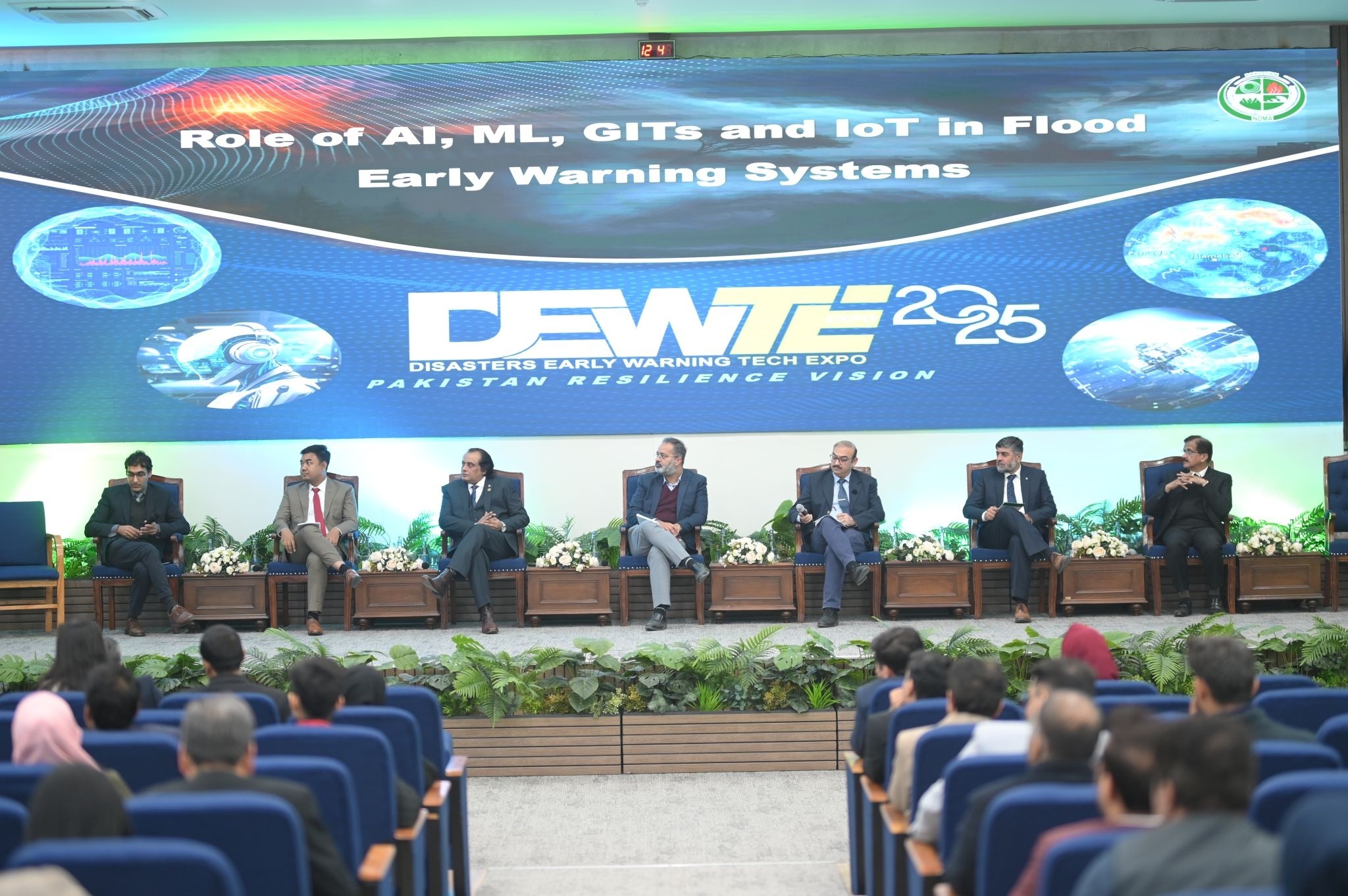
Representing the Centre for Water Informatics and Technology (WIT) at LUMS, Dr. Abubakr Muhammad participated as a panelist in the Disaster Early Warning Tech Expo (DEWTE) organized by the National Disaster Management Authority (NDMA) on 9-10 December 2025 in Islamabad. The panel discussion was themed “The Role of AI, ML, GITs, and IoT in Flood Early Warning Systems (FEWS).”
During the discussion, Dr. Abubakr highlighted key components of flood early warning systems where Artificial Intelligence (AI) and Machine Learning (ML) are either currently being applied or hold significant potential for future implementation. He critically examined the limitations related to data availability, system reliability, and infrastructure readiness, emphasizing that these constraints pose major challenges to the effective integration of advanced technologies.
Dr. Abubakr noted that Pakistan is still at an embryonic stage in the meaningful application of AI and ML for flood early warning. He stressed that the systematic performance of existing FEWS—across monitoring, forecasting, and warning generation—cannot yet be guaranteed due to prevailing uncertainties in data quality, network coverage, and operational continuity. He further discussed the concept of true alarms versus false alarms, explaining how inherent uncertainties increase the probability of false warnings, which in turn erode community trust in early warning systems.
In this context, Dr. Abubakr emphasized that Pakistan must prioritize service providers over equipment providers in the development of FEWS. This approach would ensure long-term system reliability through continuous operation, maintenance, calibration, data validation, and interpretation—rather than focusing solely on the installation of hardware without sustainable support mechanisms.
For Pakistan, he underscored that seasonal river flow monitoring, forecasting, and warning generation should form the foundational layer of future flood early warning systems. Strengthening this baseline would enable the gradual and effective integration of AI- and ML-based decision-support tools as data consistency and system maturity improve.
Moreover, Dr. Abubakr highlighted the growing importance of AI and ML in transboundary reservoir operations, particularly for analyzing upstream flow variations and predicting downstream flood risks. He also emphasized the relevance of FEWS in addressing glacial lake outburst floods (GLOFs) and managing flood risks in small catchments, where rapid hydrological responses demand high-frequency data and localized warning mechanisms.

It is pertinent to mention that, under its rigorous research and implementation mandate, the Centre for Water Informatics and Technology has deployed flood early warning systems across multiple regions of Pakistan. In Sindh, WIT— in collaboration with the Aga Khan Agency for Habitat (AKAH)—has installed FEWS in Matiari, Sujawal, and Hyderabad. Additionally, Flood Monitoring Sensors have been deployed in Swat and Namal. These systems are regularly maintained through field visits, and the data collected are systematically analyzed and utilized to support evidence-based decision-making.

Connect


