


WIT–LUMS Welcomes Dr. Muhammad Awais as Assistant Professor of Research
Share


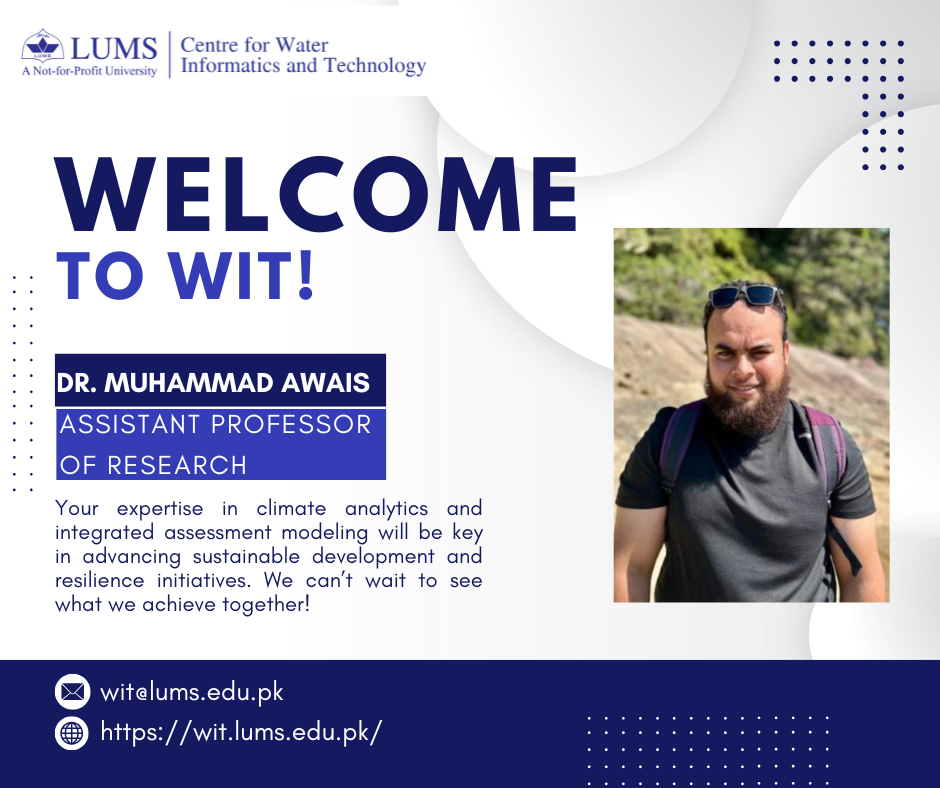 |
Dr. Muhammad Awais has joined the Centre for Water Informatics and Technology (WIT) at Lahore University of Management Sciences (LUMS) as an Assistant Professor of Research. He completed a bachelor’s degree in civil engineering from the National University of Computer & Emerging Sciences (NUCES), Pakistan, after which he moved to Germany for graduate studies. He completed his master’s degree in Hydro Science and Engineering from TU Dresden, Germany, and subsequently earned a PhD in Civil Engineering from the University of Victoria, Canada, with a research focus on climate adaptation scenarios across the energy, water, and land systems.
Dr. Awais also holds a joint appointment as a Research Scholar International Institute for Applied Systems Analysis (IIASA), in the Energy, Climate, and Environment Program. He has played a key role in several large-scale international research multi-discplinary projects, where he developed integrated, multi-sectoral scenarios at global, regional, and national scales.
His research interests center on identifying optimal transformation pathways for the energy, water, and land sectors, with a strong emphasis on climate action and its socio-environmental impacts. A core component of his work involves advancing the MESSAGEix, which is widely used to explore “what-if” scenarios related to future climate change trajectories and sustainable development pathways. His work has been published in high-impact, peer-reviewed journals, such as Nature Sustainability and Environmental Research Letters.
Beyond academia, Dr. Awais actively engages with policymakers and practitioners through stakeholder training workshops and policy dialogues, translating complex modeling outputs into actionable and impactful policy insights. He has participated in such engagements across multiple countries, including Canada, China, Zambia, Pakistan, and Austria.
At WIT–LUMS, Dr. Awais aims to expand and lead the climate analytics portfolio, advancing interdisciplinary research that leverages state-of-the-art integrated assessment tools to analyze transformational pathways across the energy, water, and agricultural sectors. His work will focus on climate adaptation and resilience in vulnerable communities in South Asia, with particular attention to climate impacts (floods, droughts, heatwaves) on health, water and energy systems. A core component of his vision is the development of a suite of cutting-edge, open-source, climate analytics tools tailored to the needs of the Global South. Alongside research, he is committed to capacity building. training students, practitioners, and stakeholders enabling evidence-based decision-making and support equitable and resilient climate transitions.

Connect


