


Reading Session I: Planetary Boundaries and System Limits
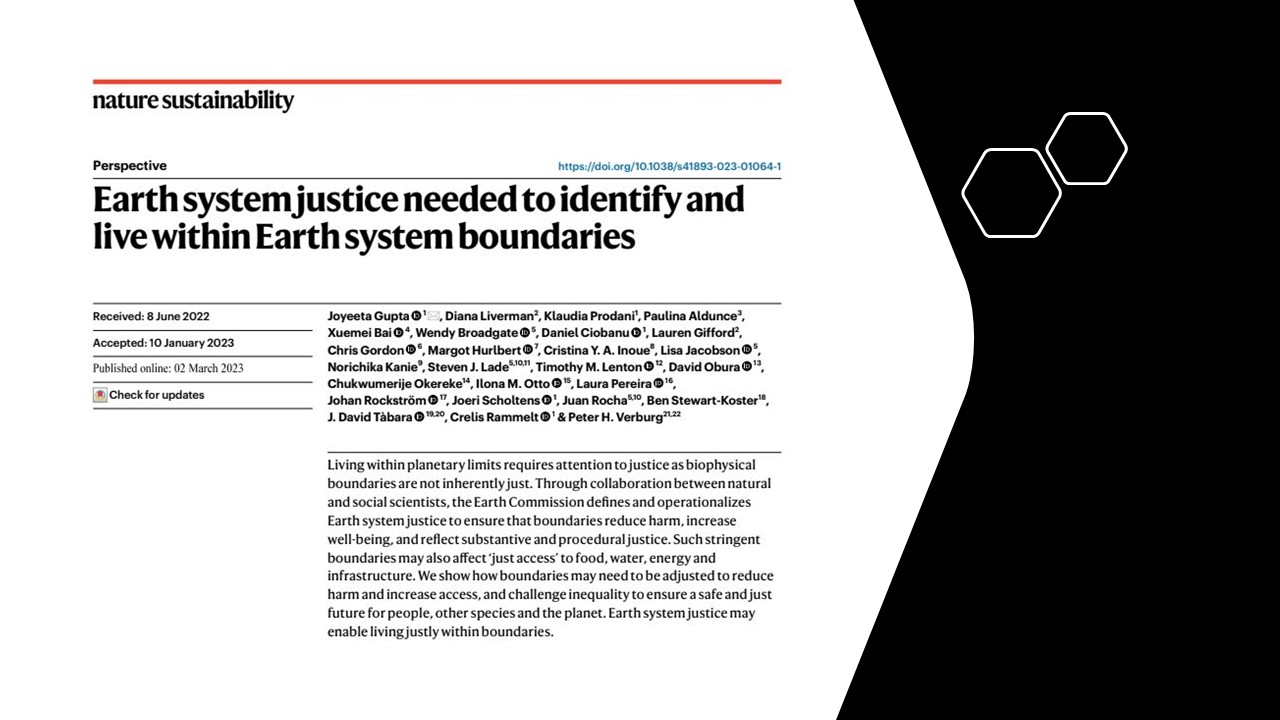
Paper's Summary
Gupta et al. (2023), published in Nature Sustainability, argue that living within planetary limits requires not just scientific rigor but a deep commitment to justice. The paper emerges from the Earth Commission, a collaboration between natural and social scientists, and introduces the concept of Earth System Justice (ESJ): the equitable sharing of nature's benefits, risks, and responsibilities among all people, within boundaries that protect both human well-being and Earth system stability. The central premise is straightforward but consequential: biophysical boundaries are morally neutral on their own, and setting them without asking who benefits, who is harmed, and who is responsible is itself an act of injustice. The authors draw on a rich body of justice scholarship to build their framework, distinguishing between recognition justice (who participates in defining problems), epistemic justice (whose knowledge counts), procedural justice (are processes fair and inclusive?), and substantive justice (are outcomes equitable?). They organize their approach around what they call the "3 Is", interspecies and Earth system stability, intergenerational justice, and intragenerational justice, insisting that obligations extend not only across human communities today, but also to future generations and to the non-human world.
Discussion Notes: Questioning Frameworks: Justice, Knowledge, and Positionality in Earth System Governance
The discussion opened with a fundamental challenge to the paper's framing: is a universal framework for Earth system justice even desirable? Participants questioned whether neatly categorizing justice into typologies risks flattening the deeply layered, context-specific nature of environmental injustice. The concern was that such frameworks, however well-intentioned, carry the risk of reproducing colonial hierarchies by privileging universalizing, and implicitly Eurocentric, modes of thinking. The paper was also critiqued for not truly operationalizing justice; rather, it distributes justice across five different forms without arriving at a coherent, actionable definition.
A recurring theme was the question of what gets included and what gets erased in scientific modeling. The paper speaks to an integrated assessment modeling community where justice has historically been absent or reduced to utilitarian cost-optimization. While the authors gesture toward non-quantifiable dimensions of justice, recognition, epistemic, procedural, anything that resists quantification tends to be excluded from the very models that inform policy. This raises a deeper institutional question: how do certain forms of knowledge get legitimized, and why is this particular discourse being pushed forward? Participants referenced Farhana Sultana's work in critical geography as an example of more genuinely interdisciplinary approaches that the paper conspicuously overlooks.
On the question of solutions, the group debated whether small, grounded narratives from specific communities could collectively build toward a larger, more just framework, or whether that aggregation itself risks abstraction and depoliticization. The example of the River Ravi and its border communities was raised as a case where two decades of lived experience could generate the kind of original, place-based narrative that scientific literature currently lacks. The Mekong River was offered as a counter-example where community-inclusive solutions have been more successfully developed. Participants broadly agreed that mixed methods approaches, where narratives are built to saturation and used to interpret quantitative analysis, offer a more honest and humane path forward than either pure quantification or pure storytelling alone.
The discussion also turned inward, with participants reflecting on positionality: who is speaking, from where, and on whose behalf. Naming and counting were identified as inherently political acts, and the risk of speaking for marginalized communities, even with good intentions, was acknowledged. Participants called for developing scholarship rooted in our own contexts, engaging directly with communities rather than treating the humanities as an add-on to scientific work. The closing suggestion was pointed and practical: definitions of justice should emerge from case studies and lived realities, not be imported wholesale from existing Northern frameworks. Questioning knowledge creation models is not a detour - it is the work itself.



