


Reading Session II: Power, Geopolitics, and System Design
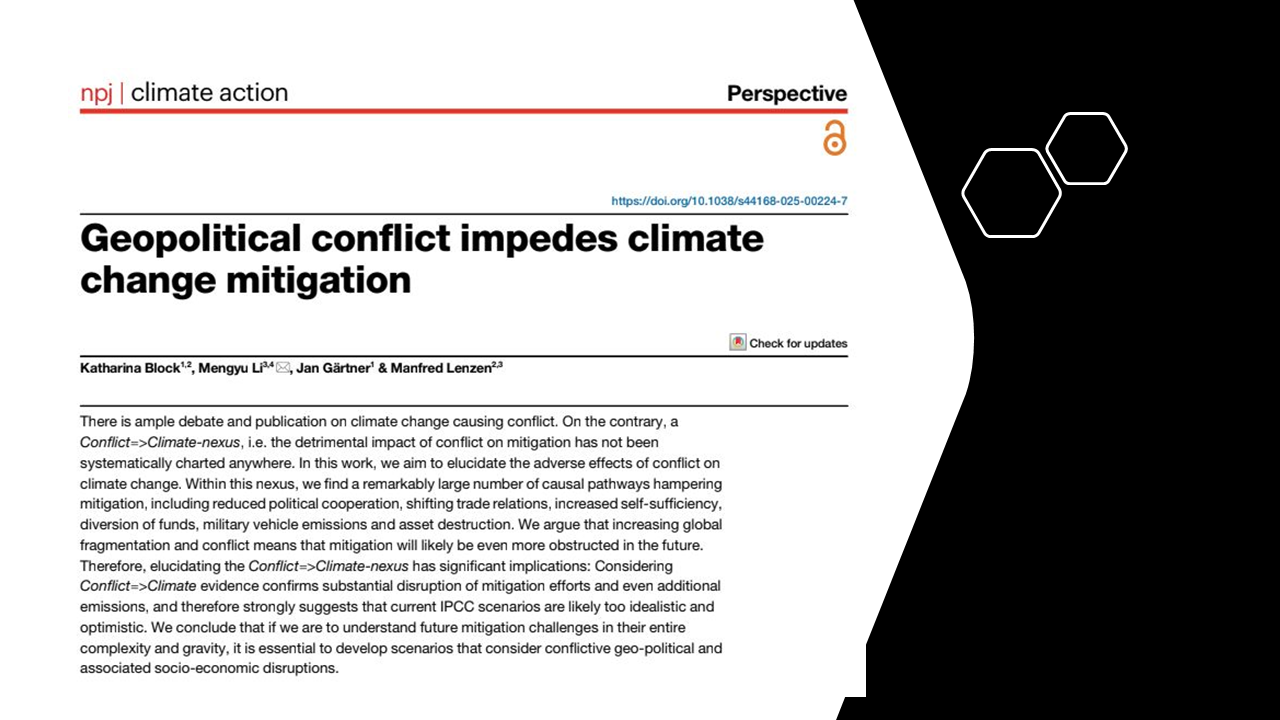
Paper's Summary
This paper by Block, Li, Gärtner, and Lenzen, published in npj Climate Action (2025), addresses a critically overlooked relationship in climate research: the detrimental impact of geopolitical conflict on climate change mitigation. While the idea that climate change causes conflict has been extensively studied and even incorporated into IPCC assessment reports, the authors argue that the reverse, conflict undermining decarbonization efforts, has never been systematically examined. They term this the Conflict-Climate nexus, and their central contention is that ignoring it renders current IPCC scenarios dangerously optimistic.
Secondary Reading: The International Court of Justice (ICJ) July 2025 Advisory Opinion on the climate obligations of countries.
Discussion Notes: Ground-Level Reflections on the Conflict-Climate Nexus
The paper's definition of conflict, drawn from the Heidelberg Institute, was seen as a useful starting point but ultimately limiting. Participants felt that conflict must be understood across multiple tiers, administrative, political, and community-level, rather than purely as state-level clashes. A local example brought this to life: the contrast between Chararr and DHA in how water well boring is regulated illustrates how resource conflict plays out very differently depending on where you stand institutionally. This calls for more expansive conceptual frameworks that can capture conflict in its everyday, granular forms, not just its geopolitical expressions.
The discussion turned naturally to questions of individual and community responsibility. Farmers were cited as an example of actors who are often willing to adopt sustainable practices but face real structural limitations in doing so. Participants reflected that existing renewable resources, where accessible, can act as buffers, not just against emissions, but against the conditions that give rise to conflict in the first place. There was also a call to take qualitative and culturally grounded approaches more seriously, including religious frameworks, rather than relying exclusively on quantitative modeling to understand the conflict-climate relationship.
Several participants noted the psychological and structural inertia at play. It is difficult to develop new ways of thinking, but even harder to dismantle old ones, and many societies, despite being deeply dependent on nature, have become profoundly disconnected from it. Overconsumption was identified as a manufactured condition, particularly visible in the global stockpiling of weapons, and participants noted that certain nations may be structurally incentivized to pursue or sustain conflict. The current US posture toward Iran was raised as a live example, with questions around whether energy market consequences are genuinely understood, or whether the calculus is simply one of securing domestic energy interests.
The conversation took on particular urgency when grounded in the Pakistani context. Conflict zones in Pakistan, participants observed, exist in a kind of double blindness; communities enter conflict without climate awareness, and emerge from it the same way. Climate simply does not factor into the calculus of survival during active conflict, and is only revisited, if at all, in its aftermath. Over the past decade, rising temperatures in Punjab have been measurable and real, yet under conditions of conflict or instability, such changes go unexamined and unaddressed. A closing observation tied these threads together: the light pollution from the coal plant in Sahiwal is already affecting surrounding crops, a quiet, local reminder that the energy-conflict-climate relationship is not abstract. It is already here.



