


Reading Session III: Justice in Models and Metrics
Paper's Summary
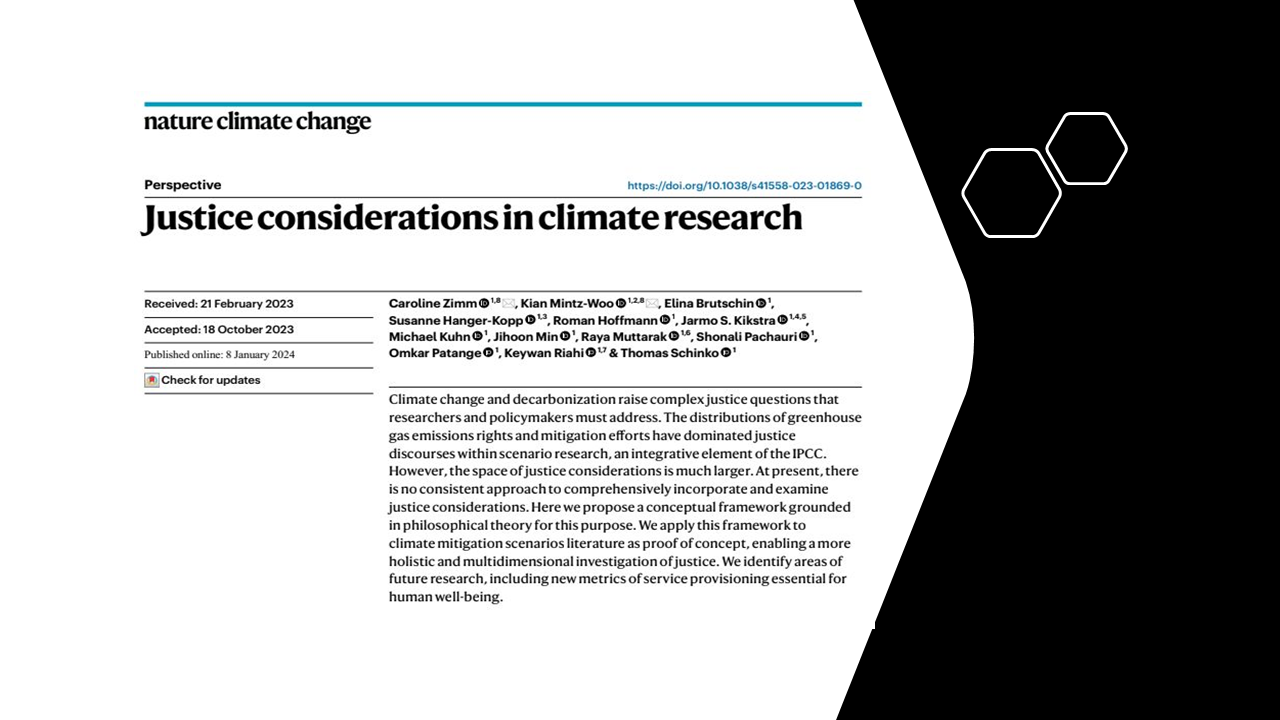
The primary reading for this session was the paper by Zimm et al. (2024), "Justice considerations in climate research," Nature Climate Change, 14, 22–30 (https://doi.org/10.1038/s41558-023-01869-0). This is a Perspective piece written by a rare mix of philosophers, social scientists, and IAM modellers. The paper audits how justice is currently treated in global climate modelling, proposes a framework drawing on philosophical theory to make different forms of justice visible and comparable across models, and calls for a Justice Model Intercomparison Project (JUSTMIP) so that justice reporting becomes as standard.
Discussion Notes: Gaps, Critiques, and Possibilities in Climate Justice Frameworks
The discussion opened with a fundamental challenge to the paper's approach: the very act of constructing a universal framework for justice risks reproducing the colonial and hierarchical thinking it claims to address. Participants questioned why justice needs to be neatly categorized into five forms at all, arguing that the issue is too layered and context-specific for such tidy compartmentalization. If justice is genuinely plural and situated, then a universally applicable framework, one that can conveniently "translate to European" contexts, may be doing more to flatten complexity than illuminate it.
A recurring critique was that the paper speaks primarily inward, to the integrated assessment modeling (IAM) community, where justice has historically been absent and where utilitarian, cost-optimization logic dominates. The authors' framework, despite its stated philosophical ambitions, still privileges what can be quantified. Anything that resists quantification, emotional loss, cultural identity, and lived experience, falls outside its scope, not because it is unimportant, but because it is inconvenient to model. Participants noted that this reflects a broader institutional problem: certain forms of knowledge get legitimized through journals, IPCC reports, and policy pipelines, while others are systematically excluded. The question of epistemic justice, who gets to produce knowledge, and whose knowledge counts, was raised as something the paper conspicuously avoids, despite invoking philosophy as its grounding.
The discussion also pointed to the paper's selective engagement with existing scholarship. Latin American, postcolonial, and critical geography scholars, such as Farhana Sultana, have been grappling with climate justice for years from non-Western, community-centered perspectives, yet this body of work goes largely unacknowledged. Participants felt there is an urgent need to develop scholarship rooted in our own contexts, drawing on community voices, local narratives, and mixed methods that go beyond two-hour field visits. Examples like the Mekong River cooperation models and work on transboundary equity along the Ravi River illustrated how deeply place-specific narratives can generate insights that no framework alone can capture.
Toward the end, the group grappled with a productive tension: quantification abstracts and risks dehumanizing communities, but so does naming and narrating on someone else's behalf. The answer, participants suggested, is not to abandon quantification or narrative, but to hold both carefully, adding more dimensions to modeling through richer community narratives, centering the marginalized, and being transparent about positionality and the limitations of one's own perspective. If the paper is treated as incomplete rather than dismissed, the more meaningful question becomes: how do we build upon it from where we stand?



